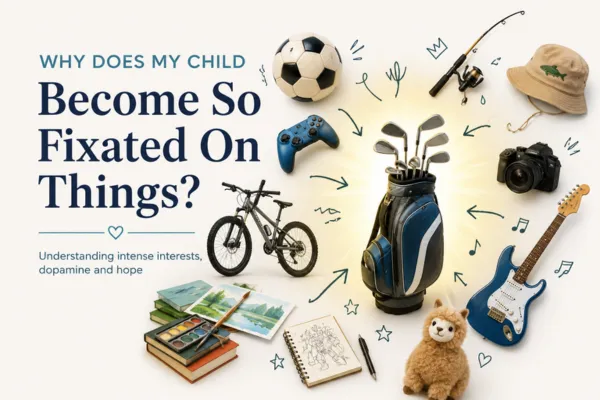
Why Does My Child Become Fixated On Things?
Why Does My Child Become Fixated On Things?
One minute it's football.
The next it's golf.
Then it's fishing.
Then it's coding.
Then it's a bike.
Or it's a puppy.
Then it's a new dress.
Then it's makeup
Then it's a new hairstyle.
Then it's something else entirely.
And once your child has decided this new thing is important, it can feel as though nothing else exists.

They talk about it constantly.
Research it endlessly.
Ask for equipment.
Watch videos.
Make plans.
And become genuinely upset if they can't have it immediately.
If this sounds familiar, you're not alone.
Many children go through phases of becoming intensely interested in something. However, for some children, particularly those with ADHD traits, the excitement, focus and emotional attachment can feel much stronger and more difficult to switch off.
It's Not Really About The Thing
From the outside, it can look as though your child is obsessed with golf, football, gaming or whatever the latest interest happens to be.
But often the fixation isn't really about the activity itself.
It's about what the activity represents.
Your child may believe:
• This will make me happy.
• This will make me successful.
• This will make me feel better.
• This will help me fit in.
• This will stop me feeling bored.
• This will finally be my thing.
The object, hobby or activity becomes attached to a powerful feeling of hope.
What's Happening Underneath
This often links to how the brain responds to stimulation.
When something is new, exciting or interesting, the brain releases a chemical called dopamine.
Dopamine creates:
• Motivation
• Focus
• Excitement
• That "this feels good" feeling
So when one activity ends, the brain naturally starts looking for another way to experience that feeling again.
For some children, particularly those with ADHD traits, that drop in stimulation can feel uncomfortable.
Almost as though something is missing.
So the new interest doesn't feel like:
👉 "This might be fun."
It feels like:
👉 "I need this."
Why It Feels So Urgent
This is why a child can seem genuinely distressed when they're told they have to wait.
The brain isn't simply thinking about a new hobby.
It's responding to:
• Loss of stimulation.
• An emotional drop.
• An urgent need to replace that feeling.
Which is why the reaction can seem much bigger than the situation itself.
It's Not Just Children
Adults do this too.
I know I do.
There was a period in my life when everything felt uncertain.
I was going through a divorce, my children were scattered across the country and I was desperately searching for something that would help me feel better.
For me, that thing became crystals.
I wasn't simply interested in crystals.
I became convinced that the next crystal was the answer.
I'd research it.
Carry it everywhere.
Talk about it constantly.
And genuinely believe that this one might finally fix how I felt.
When it didn't, I found another crystal.
Then another.
Looking back, I wasn't really chasing crystals.
I was chasing hope.
Many children do exactly the same thing with hobbies, sports, gadgets and interests.
What Helps Instead
The goal isn't to stop new interests.
Curiosity, enthusiasm and excitement are wonderful qualities.
The aim is to slow the process down and create balance.
Tip 1: Add A Pause Before Acting
Instead of saying yes or no immediately, create some space.
Try saying:
"Let's sit with it for a few days and see how you feel."
This does two things:
• Reduces the urgency.
• Tests whether the interest lasts.
Tip 2: Start Small
Instead of going all in straight away:
• Borrow equipment.
• Try a one-off session.
• Watch, explore and test it first.
This keeps the excitement without the full commitment.
Tip 3: Create A "Try Before We Buy" Rule
Help your child understand:
"We try before we invest."
This gives structure without shutting the idea down completely.
Tip 4: Keep One Steady Activity
Where possible, keep something consistent alongside new interests.
This helps reduce the emotional drop when one interest fades before another begins.
Tip 5: Name What's Happening Gently
You might say:
"It feels really exciting because it's new. Let's give it a little time and see if you still feel the same."
Over time, this helps children begin recognising the pattern for themselves.
Tip 6: Use What You Already Know About Them
As a parent or carer, you already have something incredibly valuable.
You've seen this pattern before.
You probably know roughly how long these bursts of excitement usually last.
That gives you something powerful.
Instead of reacting to the urgency, you can gently say:
"I love that idea. Let's try it first and then come back to it in a few weeks."
If they still love it then, you can look at buying equipment, finding lessons or even helping them save towards it.
This changes everything.
Instead of:
❌ Feeling pressured into making an immediate decision.
❌ Shutting the idea down.
❌ Reacting to the excitement.
You're:
✔ Slowing things down.
✔ Testing whether the interest lasts.
✔ Helping your child build patience without creating conflict.
Bringing It All Together
This pattern isn't random.
It often comes from:
• Curiosity.
• Energy.
• A brain that seeks stimulation.
These aren't negative traits.
They simply need structure around them.
The aim isn't to stop the excitement.
It's to:
Slow it down.
Contain it.
Guide it.
So it works for both of you.
Sometimes the greatest gift we can give our children isn't saying yes or no.
It's helping them learn that not everything has to happen right now.
Enjoyed This Article?
Paint The Moon was created to help parents understand children and teenagers with busy, intense and wonderfully different brains.
Join our newsletter for practical articles, tools, downloads and gentle support designed to help you make sense of behaviour, reduce overwhelm and better understand what may be happening beneath the surface.
Whether you're navigating big emotions, busy minds, fixations, overwhelm or the ups and downs of the teenage years, you're not alone.
💛 Join the Paint The Moon community below.


