When the Brain Goes Into Overwhelm
There are moments where your child's reaction feels far bigger than the situation.
A simple comment.
A change of plan.
A request they weren't expecting.
Being asked to stop doing something they enjoy.
And suddenly:
• Voices rise.
• Doors slam.
• Tears appear.
• Emotions take over.
• Or they shut down completely.
From the outside, it can look like an overreaction.
But inside the brain, something very real is happening.
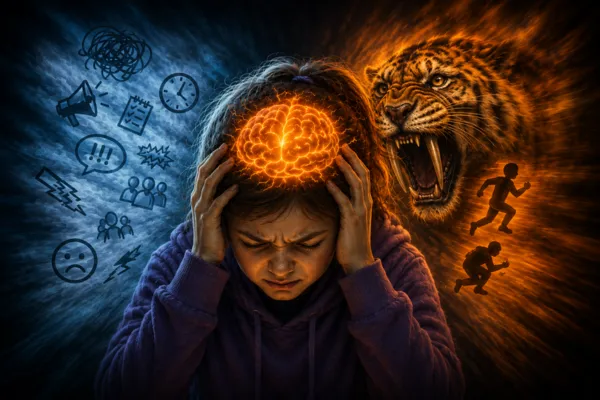
The Sabre-Toothed Tiger Is Gone... But The Alarm System Isn't

Thousands of years ago, if one of our ancestors came face to face with a sabre-toothed tiger, their brain didn't stop to think.
It reacted.
Heart racing.
Muscles ready.
Breathing faster.
Attention locked onto the danger.
The thinking part of the brain stepped back while the survival system took over.
That response helped keep us alive.
Today, most children won't ever face a sabre-toothed tiger.
But their brain still has exactly the same alarm system.
The difference is that today's "tigers" can be things like:
• A sudden change of plan.
• Feeling criticised.
• Too much noise.
• Too many demands.
• Feeling misunderstood.
• Being overwhelmed.
To us, these situations may not seem dangerous.
But to an overwhelmed brain, they can trigger exactly the same automatic response.
What Fight or Flight Actually Means
Every brain has a built-in alarm system designed to keep us safe.
When the brain senses something it doesn't like—uncertainty, pressure, criticism or overwhelm—it can switch into fight or flight mode.
This isn't a conscious choice.
It's automatic.
In that moment:
• The emotional brain takes over.
• The thinking part of the brain steps back.
• The body prepares to react.
What This Looks Like
Fight can look like:
• Arguing.
• Shouting.
• Snapping.
• Pushing back.
Flight can look like:
• Walking away.
• Going quiet.
• Shutting down.
• Avoiding the situation.
Some children move between both.
Why It Happens So Quickly
Children with busy brains are often already processing a huge amount of information.
Thoughts.
Emotions.
Sounds.
Movement.
Expectations.
Changes.
For some children, including many with ADHD traits, the threshold for overwhelm can be lower.
It doesn't always take much for the system to tip over.
The Important Bit
Once your child is in this state:
Logic doesn't land.
Long explanations don't help.
Consequences often make things worse.
Because the brain is no longer in "thinking mode."
It's in survival mode.
Trying to reason with an overwhelmed brain is a bit like asking someone to solve a maths problem while they're running away from that sabre-toothed tiger.
Their brain simply isn't ready for it yet.
Why Shouting Makes It Worse
When emotions rise, shouting can feel like the natural response.
It's quick.
It's reactive.
It's human.
But to a busy brain, shouting doesn't bring control.
It adds more pressure.
When a voice becomes louder or sharper, the brain doesn't just hear words.
It hears:
"Something is wrong."
"This isn't safe."
"I need to react."
So instead of calming down, the alarm system becomes even louder.
The Escalation Pattern
It often looks like this:
Child feels overwhelmed.
⬇️
Adult raises their voice.
⬇️
Brain senses more threat.
⬇️
Reaction becomes bigger.
⬇️
Everyone feels frustrated.
Before long, both sides feel:
• Unheard.
• Misunderstood.
• Emotionally exhausted.
What Helps Instead
The goal in that moment isn't to correct behaviour.
It's to calm the nervous system.
That might mean:
• Lowering your voice.
• Using fewer words.
• Giving your child a little space.
• Taking a slow breath before responding.
You don't need perfect calm.
Just less intensity.
Sometimes that small change is enough to stop the situation becoming something much bigger.
Bringing It All Together
When a child's brain goes into overwhelm, they aren't choosing to react this way.
Their brain is doing exactly what it was designed to do.
Protect them.
Once you understand that, your response begins to change.
Instead of asking:
"How do I stop this behaviour?"
You begin asking:
"What is their brain trying to protect them from right now?"
That one question can change everything.
Because calm doesn't just help your child.
It helps their brain feel safe enough to start thinking again.
Enjoyed This Article?
Paint The Moon was created to help parents understand children and teenagers with busy, intense and wonderfully different brains.
Join our newsletter for practical articles, tools, downloads and gentle support designed to help you make sense of behaviour, reduce overwhelm and better understand what may be happening beneath the surface.
Whether you're navigating big emotions, busy minds, fixations, overwhelm or the ups and downs of parenting, you're not alone.
💛 Join the Paint The Moon community below.


