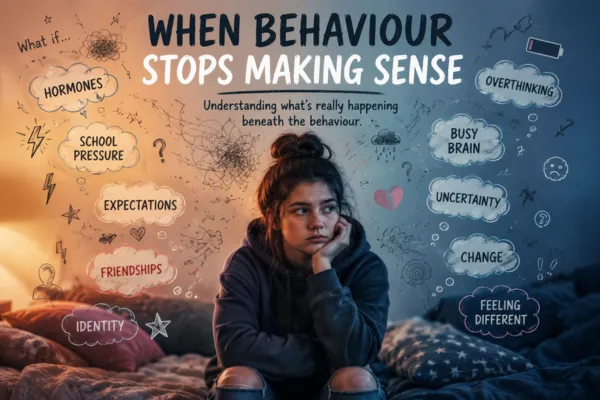
When Behaviour Stops Making Sense
There often comes a point where a teenager's behaviour stops feeling predictable.
One moment they are funny, thoughtful, kind and completely themselves.
The next, they are overwhelmed, reactive, withdrawn or distant.
And it's not just the behaviour — it's the unpredictability of it.
You might find yourself thinking:
• Why does everything turn into an argument?
• Why can they be so capable one minute and completely stuck the next?
• Why do they seem constantly bored, yet unable to settle?
• Why do they take things so personally?
Over time, this can feel exhausting.
Not just physically, but emotionally.
Because you're not just responding to behaviour — you're trying to understand someone you care deeply about.
And when behaviour doesn't make sense, it's very easy for it to feel:
• Frustrating
• Confusing
• Sometimes even personal
But in many cases, what you are seeing is not random.
It is a pattern.
A pattern that comes from how the brain is processing:
• Emotion
• Stimulation
• Pressure
• Expectation
This article is here to help you recognise those patterns.
Not to label.
Not to diagnose.
But to make sense of what you're seeing, so your response can begin to shift from reacting… to understanding.
A Note On Labels
Some of the patterns described in this article are often associated with ADHD or autistic traits.
For some families, having a name for it can feel helpful.
It can bring clarity, validation and access to support.
For others, labels feel unnecessary or even restrictive.
They may prefer to focus on understanding behaviour rather than defining it.
This article is not built around labels.
It's built around experience.
Because whether or not a label is used, the day-to-day reality remains the same:
Supporting a young person whose brain works differently.
If something in this article resonates, that understanding alone can be powerful.
The Teenage Brain Is Already A Storm
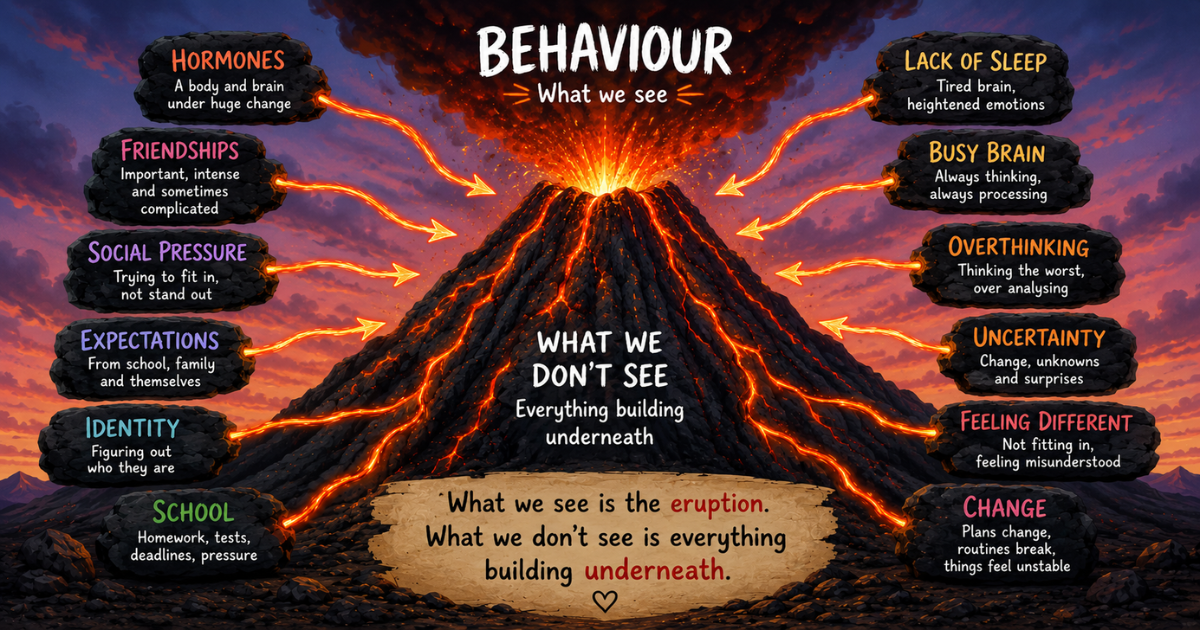
Before we even begin to look at individual differences, it's important to understand something fundamental:
The teenage brain is already going through a huge transition.
During adolescence, the brain is being rewired.
The emotional centre becomes highly active, while the part responsible for planning, reasoning and impulse control is still developing.
This means that emotions can feel:
• Stronger
• Faster
• Harder to manage
At the same time, teenagers are navigating:
• Friendships
• Identity
• Independence
• Expectations
• Social pressure
Even without additional challenges, this can feel intense.
Now Add A Busy Brain
Some teenagers are not only going through this stage — they are doing it with a brain that is already:
• Fast-thinking
• Highly aware
• Sensitive to their environment
• Easily overstimulated
They may notice things others don't:
• Tone of voice
• Changes in mood
• Unfairness
• Uncertainty
Their brain is constantly processing.
What This Looks Like From The Outside
Without understanding, it can look like:
• Overreacting
• Being dramatic
• Attention-seeking
• Deliberately difficult
But what is often happening is something very different:
A nervous system reaching its limit.
Real-Life Example
A simple change of plan.
To an adult, it may feel small.
To a busy brain, it can feel like:
• Loss of control
• Uncertainty
• Something unexpected
And suddenly, a small moment becomes a big reaction.

Paint The Moon Tip
When a reaction feels bigger than the situation, gently pause and ask:
"What might this feel like from their side?"
This simple question can shift your response immediately.
Sometimes behaviour makes a lot more sense when we stop looking at what is happening and start wondering what it feels like.
Enjoyed This Article?
Paint The Moon was created to help parents understand children with busy, intense and wonderfully different brains.
Join our newsletter for practical articles, tools, downloads and gentle support designed to help you navigate the challenges of parenting with greater confidence and understanding.
Whether you're dealing with big emotions, fixations, overwhelm, busy minds or simply trying to make sense of behaviour that doesn't always seem to make sense, you're not alone.
Join the Paint The Moon community below.


