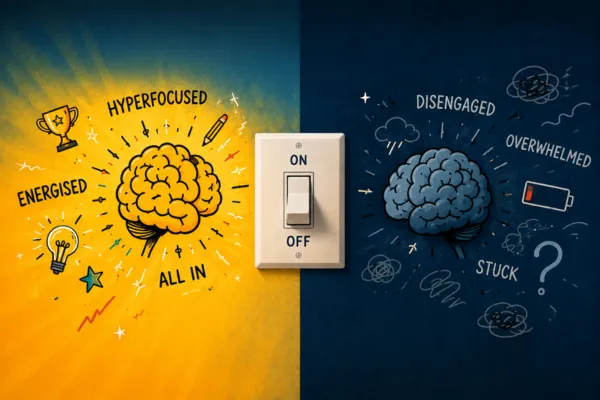
The Busy or All-or-Nothing Brain
Some teenagers don't seem to operate in the middle.
They don't gradually move from calm to stressed.
They don't slowly lose interest.
Instead, they often move quickly between states:
• Fully engaged → Completely disengaged
• Calm → Overwhelmed
• Focused → Restless
• Motivated → Stuck
• Excited → Bored
This is often described as an all-or-nothing pattern.
To the people around them, it can seem confusing.
Even frustrating.
But for many teenagers, it feels just as confusing from the inside.
What This Looks Like Day To Day
You might notice:
• They can focus deeply on something they enjoy.
• They can spend hours researching a hobby or interest.
• They seem incredibly knowledgeable about topics they care about.
• Yet they struggle to start something that feels boring or overwhelming.
• They have bursts of energy, followed by periods of shutdown.
• They seem capable one moment and completely stuck the next.
This inconsistency can be difficult to understand.
Especially when you've seen what they are capable of.
"But I Know They Can Do It"

This is often one of the most confusing parts for parents.
You've seen your teenager:
• Complete a project they're passionate about.
• Learn complex information.
• Spend hours concentrating on something they enjoy.
So when they struggle to start homework, tidy their room or complete a simple task, it can be tempting to think:
"They just can't be bothered."
But in many cases, it isn't about ability.
It's about how the brain regulates:
• Attention
• Energy
• Interest
• Motivation
Some tasks create enough stimulation for the brain to engage.
Others don't.
What It Feels Like For Them
From the outside, it can look like:
"They're being lazy."
"They're avoiding it."
"They don't care."
From the inside, it often feels very different.
It can sound more like:
• "I don't know where to start."
• "This feels too much."
• "My brain won't settle."
• "I want to do it, but I can't get going."
• "I don't know why I'm stuck."
This can be incredibly frustrating for the young person too.
Many teenagers are fully aware that they need to do something.
The difficulty is getting started.
The Overwhelm Trap
When a task feels large, the brain can become overwhelmed before it has even begun.
The teenager isn't necessarily thinking:
"I don't want to do this."
They may be thinking:
"Where do I start?"
"What if I get it wrong?"
"There's too much to do."
The result is often avoidance.
Not because they don't care.
But because the task feels bigger than their brain can currently manage.
Paint The Moon Tip
Reduce the starting point.
Instead of:
"Do your homework."
Try:
"Let's just start with the first question."
Instead of:
"Clean your room."
Try:
"Let's start by putting the clothes away."
Small starts reduce overwhelm.
And once the brain gets moving, continuing often feels much easier than starting.
Enjoyed This Article?
Paint The Moon was created to help parents understand children and teenagers with busy, intense and wonderfully different brains.
Join our newsletter for practical articles, tools, downloads and gentle support designed to help you make sense of behaviour, reduce overwhelm and better understand what may be happening beneath the surface.
Whether you're navigating big emotions, busy minds, fixations, overwhelm or the ups and downs of the teenage years, you're not alone.
Join the Paint The Moon community below.


